General
How Broken Item Price Is Set: a Practical Guide
Sell your broken iPhone, laptop, or PS5 on BrokenBuys — the only marketplace built exclusively for broken and damaged electronics.

How Broken Item Price Is Set: a Practical Guide
Most people assume the price of a broken item is simply whatever it costs to fix it, minus a little profit margin. That assumption is wrong, and it costs sellers real money. Understanding how broken item price is set means looking at market perception, buyer psychology, damage severity, and the channel you choose to sell through. All of these factors interact in ways that can push a price up or down by 50% or more. This guide breaks down the full picture so you can price smarter, sell faster, and leave less money on the table.
Table of Contents
Key takeaways
| Point | Details |
|---|---|
| Damage severity drives value loss | Minor damage reduces value by 5-10%, while severe structural damage can cut it by 30-50%. |
| Repair cost is not the price | Market perception and buyer sentiment often matter more than the actual cost to fix an item. |
| Channel choice changes everything | Recyclers offer predictable but lower payouts; online marketplaces reward effort with higher returns. |
| Comparable sales are your anchor | Research 5-10 recent sales of similar damaged items before setting any asking price. |
| Presentation affects final price | Quality photos and accurate descriptions can meaningfully increase what a buyer is willing to pay. |
How broken item price is set: the core factors
Price determination for damaged goods starts with one deceptively simple question: how bad is the damage, really? The answer has layers.
Damage falls into three broad tiers, and each tier carries a predictable range of value loss. Minor cosmetic damage, a scuff on a laptop lid or a small crack on a phone screen, typically results in a 5-10% drop from market value. Moderate damage that affects function but is still repairable, like a washing machine with a broken pump or a car with a bent fender, usually causes a 10-20% reduction. Severe structural damage, the kind that makes a buyer question whether the item is worth saving at all, can drop resale value by 30-50%.
But here is where most sellers go wrong. They price based on repair cost alone, as if every buyer plans to fix the item and resell it. Many buyers, especially parts hunters, repair technicians, and refurbishers, have completely different math. A broken iPhone 14 with a cracked screen might cost $150 to fix professionally, but a repair tech buying it for parts only needs the logic board and battery. Their ceiling price has nothing to do with a full repair quote.
Buyer stigma is another underappreciated force. Structural or fire damage creates psychological resistance in buyers that goes beyond rational cost calculations. A house with fire damage in the kitchen, even after full remediation, carries a stigma that pushes buyers to demand a deeper discount than the repair cost would justify. The same dynamic applies to water-damaged electronics, flood-title vehicles, and structurally compromised furniture. Buyers price in their uncertainty, not just the known repair bill.
Pro Tip: When evaluating your item, separate cosmetic damage from functional damage. Buyers care far more about whether something works than whether it looks perfect.
Valuation methods and formulas that actually work
Knowing that damage affects price is one thing. Having a formula to calculate it is another. Several proven methods exist, and the right one depends on what you are selling.
Tiered percentage pricing
The most accessible method for everyday sellers uses condition tiers as a percentage of retail value. Standard condition tiers work like this:
-
Like-new condition: price at roughly 50% of current retail
-
Gently used with minor flaws: price at around 30% of retail
-
Well-worn or noticeably damaged: price at approximately 10% of retail
For broken items, you are typically working in that third tier or below it. A broken Nintendo Switch that retails for $300 might start at $30-50 using this framework, then adjust up or down based on what specific parts are intact and what the current market demand looks like.
Diminished value calculation
For vehicles, a more detailed formula is standard. Diminished value calculations factor in mileage, damage severity, repair quality, title status, and comparable market sales. A car that was worth $20,000 before an accident, with moderate structural damage and a salvage title, might have its diminished value calculated by applying a severity multiplier to the base value, then adjusting further for mileage and repair quality scores.
The critical insight here is that market comps outperform formulas in real-world accuracy. A formula gives you a starting point. What similar damaged vehicles actually sold for last month tells you where the market actually sits.
Disruption-level pricing for unique items
In specialized markets like collectibles or gaming economies, rarity plays a role that repair cost cannot explain. Epic-tier game items carry repair costs roughly 67% higher than lower-tier items, not because they are harder to fix, but because the economy needs to regulate their scarcity. The same logic applies to a broken limited-edition watch or a damaged rare collectible. Rarity creates a price floor that damage cannot fully erase.
| Valuation method | Best used for | Key inputs |
|---|---|---|
| Tiered percentage | Consumer goods, electronics, furniture | Retail price, condition tier |
| Diminished value formula | Vehicles, high-value assets | Mileage, severity, title status, comps |
| Market comps only | Collectibles, luxury items, rare goods | Recent comparable sales |
| Maximum Allowable Offer | Real estate, major appliances | After-repair value, repair cost buffer |
Pro Tip: For high-value broken items, pull at least 5 recent comparable sales before committing to a price. One outlier sale, high or low, can mislead you badly.
How your sales channel shapes the final price
The same broken item can fetch wildly different prices depending on where you sell it. This is one of the most overlooked factors in pricing strategy for broken goods.

Recyclers and buyback programs offer speed and certainty, but you pay for that convenience. Cracked smartphones sold to recyclers typically receive 30-50% less than their undamaged retail value, and the recycler sets the price with no negotiation. If your broken iPhone 14 retails at $600, a recycler might offer $90-120. Predictable, but not generous.
Online peer-to-peer marketplaces can return significantly more, but they require effort. You need good photos, an accurate description, and some patience. The tradeoff is real: a well-listed damaged phone on a marketplace can outperform a recycler offer by 40-60% when the listing is done right.
Trade-in programs at major retailers sit somewhere in the middle. They apply steep damage penalties, often discounting broken items by 60-80% compared to a working device, and they only accept certain categories. A broken DeWalt drill or a damaged couch will not qualify.
Here is what changes the outcome most on peer-to-peer platforms:
-
Photo quality: Clear, well-lit images of both the damage and the working components signal honesty and attract serious buyers
-
Damage specificity: Buyers who know exactly what is broken can assess their own repair costs. Vague listings create doubt and lower offers
-
Timing: Listing a broken PS5 right after a major game release, when demand for consoles spikes, yields better results than listing in a slow period
-
Buyer targeting: Listing in a channel where repair technicians, parts hunters, and flippers actively shop means your buyer pool already understands broken item value
Good photography and timing can push a damaged phone listing above what any recycler would offer, even when the damage is identical. The channel is not neutral. It actively shapes what your item is worth.
Strategies to price broken items and maximize your return
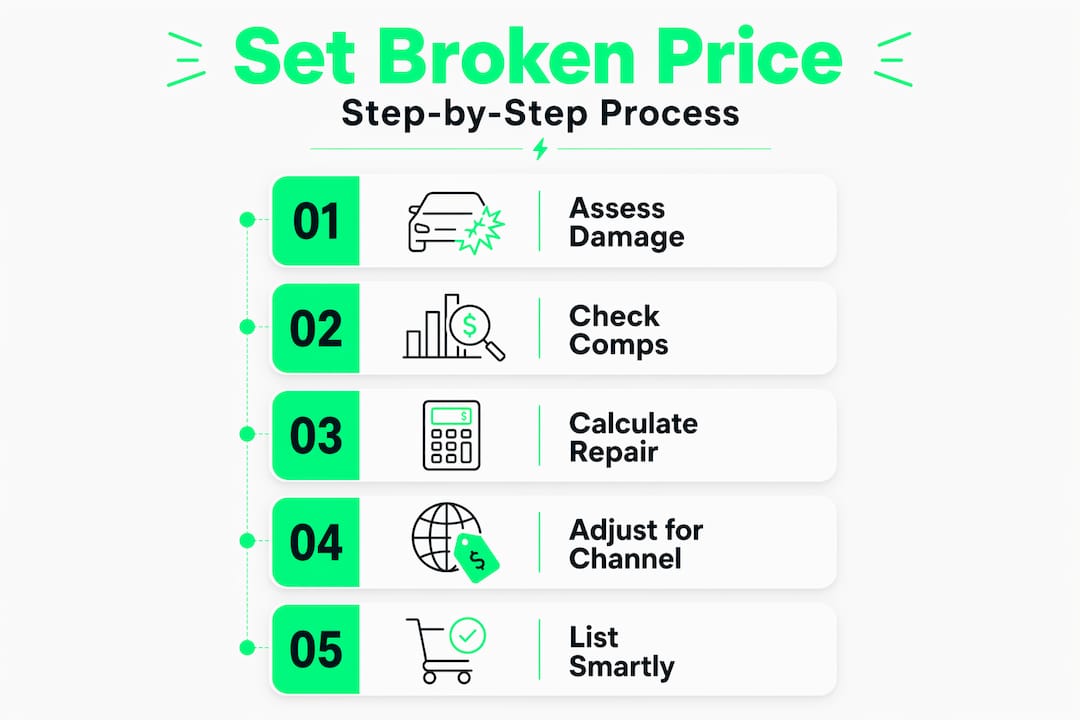
Putting all of this together into a practical process is where most sellers get stuck. Here is a clear sequence that works across categories.
Start with comparable sales research. Search for your specific item in broken or damaged condition on active marketplaces and note what completed sales actually closed at, not just asking prices. Asking prices are wishes. Closed sales are reality. Pull 5-10 comps within the last 90 days if possible.
Next, factor in repair costs with a buffer. If a buyer would need to spend $200 to fix your item, that cost should reduce your asking price, but not dollar-for-dollar. Buyers price in risk, uncertainty, and their own labor. A repair contingency buffer of 15-25% beyond the known repair cost is standard in professional damaged-goods pricing. Build that into your math.
Then adjust for demand and psychology. A broken MacBook sells faster than a broken generic laptop because the parts market is deeper and buyer demand is higher. A broken Rolex sells faster than a broken fashion watch for the same reason. High-demand broken items can be priced closer to the top of your comp range. Low-demand items need to sit at the bottom or below it to move.
Pro Tip: If your item has been listed for more than two weeks without serious offers, drop the price by 10-15% rather than waiting. Stale listings lose credibility with experienced buyers.
Finally, decide whether a minor repair is worth doing before listing. Replacing a $15 screen protector or cleaning corrosion from battery contacts can shift a listing from the “well-worn” tier to the “gently used” tier, potentially doubling your sale price for minimal investment. The math does not always work out, but it is worth calculating before you list.
My honest take on pricing broken items
I have watched sellers leave serious money behind by anchoring too hard to what they paid for something or what it costs to fix it. Neither number is what the market cares about. The market cares about what a buyer can do with the item right now, and what risk they are taking on by buying it.
The repair cost figure is context, not a price. I have seen a broken luxury watch sell for three times what a full repair quote suggested because the buyer wanted the movement for a restoration project and the case was in perfect shape. I have also seen structurally damaged vehicles priced at near-working values sit unsold for months because the seller could not separate their emotional attachment from the buyer’s rational risk calculation.
Honest condition representation is not just ethical. It is financially smart. Buyers who feel deceived leave bad reviews, open disputes, and tell others. Buyers who feel they got an accurate picture of what they purchased come back and refer others. On a platform like Brokenbuys, where verified seller ratings matter, your reputation compounds over time in ways that a single inflated sale price never will.
The sellers I have seen do best in this market are the ones who price quickly, price honestly, and target the right buyer pool from the start. They do not wait for a unicorn buyer who will overpay. They price to attract the repair tech or flipper who already knows the item’s real value and will pay a fair price to get it.
— Ryan
Sell your broken items where buyers are already looking
If you have worked through this guide and are ready to list, the channel you choose matters as much as the price you set. Brokenbuys is the only dedicated peer-to-peer marketplace built exclusively for broken, damaged, and salvage items across every category.
Unlike general marketplaces where broken listings get buried under working items, Brokenbuys puts your damaged goods in front of the buyers who specifically want them: repair technicians, parts hunters, refurbishers, and flippers. Every transaction includes secure escrow payments through Stripe and full buyer and seller protection. You can ship nationally or sell locally, and all conditions are accepted. If you have a broken item and a fair price in mind, this is where that transaction belongs.
FAQ
What is the biggest factor in setting a broken item’s price?
Market perception and buyer demand matter more than repair cost alone. Comparable sales data from similar damaged items gives you a more accurate price than any repair quote.
How much does damage reduce an item’s resale value?
It depends on severity. Minor damage typically causes a 5-10% value drop, moderate damage causes 10-20%, and severe structural damage can reduce value by 30-50% depending on the item type.
Does better photography actually change what a broken item sells for?
Yes, significantly. Well-photographed damaged phones consistently sell for more than recycler offers, even with identical damage, because photos build buyer confidence and reduce perceived risk.
Should I repair a broken item before selling it?
Only if the repair cost is low relative to the price increase it unlocks. Calculate the tier jump: if a $20 fix moves your item from the 10% tier to the 30% tier on a $300 item, that is a $60 gain on a $20 investment. If the math does not work, sell it as-is.
How do I find comparable sales for a broken item?
Search completed listings on active peer-to-peer marketplaces filtering for your specific item in damaged or broken condition. Collect 5-10 closed sales within the last 90 days and use the median price, not the highest, as your reference point.